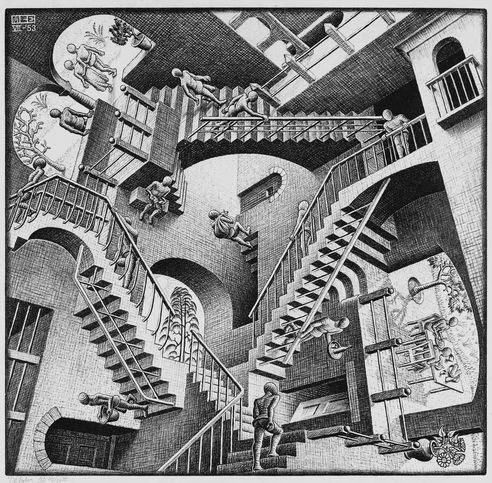
Zibaldone

Così tra questa
Immensità s'annega il pensier mio:
E il naufragar m'è dolce in questo mare.

Al Principio No Se Lee

Al principio no se lee. Al amanecer de la vida, al alba de los ojos. Se traga la vida por la boca, por las manos, pero todavía no se manchan los ojos de tinta. En los comienzos de la vida, en las primeras fuentes, en los primeros arroyuelos de la infancia, no se lee, ni se tiene siquiera la idea de leer, de cerrar tras de sí, de un golpe, la página de un libro, la puerta de una frase. No, al principio todo es más sencillo. Quizá más loco. No se está separado de nada, por nada. Se está en un continente sin verdaderos límites, y ese continente es uno mismo. Al principio están las tierras inmensas del juego, las grandes praderas de la invención, los ríos de los primeros pasos, y por todas partes, alrededor, el océano de la madre, las olas que bate la voz materna. Todo eso es uno, sin ruptura, sin desgarro. Un espacio infinito, fácilmente medible. No hay libros ahí dentro. No hay lugar para la lectura, para ese asombrado duelo que es aprender a leer.

Además, los niños no soportan ver a su madre leyendo. Le arrancan el libro de las manos, exigen una presencia entera, y no esa presencia incierta, corrompida por el ensueño. La lectura entra mucho más tarde en la infancia. Primero hay que esperar, y es como un sufrimiento, los primeros tiempos del exilio. Se aprende la soledad letra tras letra, con el dedo sobre el corazón, subrayando cada vocal con sangre roja. Los padres están contentos de ver a su hijo leer, aprender, sufrir. Siempre tienen, en secreto, el temor de que su hijo no sea como los demás, de que no consiga tragarse el alfabeto, de deglutirlo en frases bien asentadas, bien derechas, bien masticadas.

La lectura es un misterio. Cómo se llega a ella, no se sabe. Los métodos son lo que son, no importa. Un día se reconoce una palabra en la página, se la pronuncia en voz alta, y es un pedazo de dios que se marcha, una primera fractura del paraíso. Se continúa con la palabra siguiente, y el universo que formaba un todo ya no es más que frases, tierras perdidas en el blanco de la página. Se está en la escuela, se cumple el oficio de niño. Es verdad que hay una gran felicidad en esa pérdida, en ese primer descubrimiento de la lectura, en su capacidad para descifrar una página, para contemplar las sombras. Es incluso algo más fuerte que la felicidad: para ser justos, habría que hablar de alegría. De alegría y de espanto. La alegría va siempre acompañada del espanto, los libros van siempre acompañados del duelo.

Después, después de este primer fin del mundo, comienza otra cosa. Para muchos, el aburrimiento. Con la lectura se compra algo que para uno no tiene ningún valor -solo tiene un precio : un lugar en el banco de la clase, un papel en las oficinas o en las fábricas. Entonces se abandona. Se lee solo lo necesario, por obligación. Ya no hay alegría en ello, ni tampoco placer: solo obediencia, la obediencia necesaria para llegar hasta el final de los estudios, hasta las puertas del desierto.

Después no se lee nada, ni siquiera el periódico. Se forma parte de esa gente que no tiene un solo libro en casa; esa gente, un verdadero misterio para los escritores, esas casas bajo la arena, esas vidas en las que nada puede entrar, ni el diablo ni los libros. A veces, un diccionario, una enciclopedia vendida por un representante más astuto que los demás, pero no se leerán: son para los hijos, para el futuro, para los días malos. Son como un mueble, un mueble un poco extraño, no de roble ni de pino, un pequeño mueble de veinte volúmenes de papel, pagado a plazos, que no se tocará.

A veces también sucede algo, a unos pocos, a muchos menos. Esos son los lectores. Comienzan su carrera a la edad en que los demás abandonan la suya: hacia los ocho, los nueve años. Se lanzan a la lectura y pronto no terminan nunca, descubren con alegría que no tiene fin. Con alegría y con espanto. Permanecen, al principio, en la primera experiencia. Es insuperable. Leerán hasta el final de sus vidas permaneciendo siempre ahí, al borde del primer descubrimiento, el de la soledad, la soledad de las lenguas, la soledad de las almas.

Con arrobamiento abandonan el mundo para dirigirse hacia esa soledad. Y cuanto más avanzan, más profunda se vuelve. Y cuanto más leen, menos saben. Esos son los que hacen vivir a los escritores, a los libreros, a los editores, a los impresores. Los grandes libros, los malos libros, los periódicos: todo es bueno para quien ama leer, todo es alimento para el hambriento.

Por un lado, los que nunca leen. Por otro, los que ya no hacen otra cosa que leer. Hay muchas fronteras entre las personas. El dinero, por ejemplo. Esa frontera, entre los lectores y los demás, es aún más cerrada que la del dinero. Quien no tiene dinero carece de todo. Quien no tiene lectura carece de la propia carencia.

La muralla entre ricos y pobres es visible. Puede desplazarse o derrumbarse en algunos lugares. La muralla entre los lectores y los demás está mucho más hundida en la tierra, bajo los rostros. Hay ricos que no tocan un solo libro. Hay pobres devorados por la pasión de leer. ¿Dónde están los pobres, dónde están los ricos? ¿Dónde están los muertos, dónde están los vivos? Es imposible decirlo.

Los que nunca leen forman un pueblo taciturno. Los objetos hacen las veces de palabras: los automóviles con asientos de cuero cuando hay dinero, los adornos sobre los tapetes cuando no lo hay. Al leer, uno sale de su vida, la cambia por el espíritu del ensueño, por la llama del viento. Una vida sin lectura es una vida de la que uno nunca sale, una vida amontonada, asfixiada por todo lo que retiene, como en esas historias del periódico en las que se fuerzan las puertas de una casa invadida hasta el techo por la basura.

Está la mano blanca de quienes tienen el dinero de su parte. Está la mano fina de quienes tienen el ensueño de su parte. Y están todos aquellos que no tienen mano: privados de oro, privados de tinta.

Por eso se escribe. Solo puede ser por eso, y cuando es por otra cosa, no tiene interés: para ir de unos a otros. Para acabar con la fragmentación del mundo, para acabar con el sistema de castas y, por fin, tocar a los intocables. Para ofrecer un libro a quienes nunca lo leerán.

Lire l'article
1 0 S E P T septembre 2 0 2 6

On Naturalism and the God Hypothesis

The perennial dispute between naturalism and theism has found renewed public expression recently, symptomatic of a broader return to metaphysical inquiry in Anglophone intellectual culture, one notably more pronounced than in the secular traditions of Western Europe. The present article takes this contemporary controversy as its occasion but not its object: rather than commenting on the debate's cultural symptoms, it descends to its philosophical foundations, examining the strongest arguments on both sides from a position of deliberate symmetry. Theism and naturalism begin here on equal footing. Yet this symmetry of exposition does not entail neutrality of conclusion; I proceed explicitly from the perspective of a fair agnostic naturalism. The recurring claim in contemporary philosophy of religion that science presupposes intelligibility and therefore requires a transcendent ontological ground is more rhetorically compelling than it is philosophically conclusive. Classical theism, dressed in Thomistic or neo-Platonic language, presents itself as the only serious answer to the question "why is there ordered reality at all?" But on closer inspection, theism does not answer this question either. It merely relabels the mystery and declares victory.

But the argument that follows is not a defence of scientism either. It accepts that science cannot self-justify its own preconditions from within its methods alone. What it contests is the inference that this epistemic gap requires filling with a personal, necessary being. That inference is a non sequitur and an expensive one. I will examine it from the perspective of a fair agnostic naturalism.

I. The Presupposition Argument and Its Real Force

The strongest version of the theistic challenge runs as follows: science operates by assuming that reality is intelligible, that reason is reliable, and that the uniformity of nature holds. None of these can be demonstrated by science without circularity. Therefore science borrows ontological capital it cannot itself generate. Classical theism, by identifying God with being itself (esse ipsum in Aquinas's formulation), offers a ground for intelligibility that is not an additional hypothesis inside the system but the very condition for any system at all.

"Science does not require revealed religion, scripture, or ecclesial authority but it does require real being, intelligibility, normativity, truth, and real good. If those are denied, science collapses into instrumentalism."
The theistic position under examination

This is genuinely, to me, the strongest version of the argument and deserves respect. This line of thought has deep roots. It echoes Alvin Plantinga’s influential evolutionary argument against naturalism (the worry that unguided evolution would undermine our confidence in reason itself), C.S. Lewis’s classic argument from reason, and, much earlier, Leibniz’s principle of sufficient reason, the demand that everything must ultimately have an explanation. The intuition that a merely contingent universe cannot account for its own rational transparency is not trivially dismissed.

And yet, I think, it fails, not because the intuition is wrong, but because the proposed solution repeats the problem at a higher level of abstraction, while introducing additional difficulties of its own.

II. The Symmetry Problem: Brute Facts All the Way Down

The decisive objection, it seems to me, lies in what we might call the symmetry of explanatory termination, in other words, both naturalism and classical theism eventually reach a point where they must simply say this is how reality fundamentally is, with no further explanation available.. Both naturalism and classical theism ultimately terminate explanation in a brute, ungrounded fact. Naturalism terminates in a self-consistent, structured universe, ordered, law-like, and intelligible as a fundamental feature. Theism terminates in a God whose nature is necessarily rational, necessarily good, and necessarily existent. The real question, then, and one I have returned to repeatedly, is simply which stopping-point is more parsimonious.

If naturalism owes an explanation for why reality is intelligible, theism equally owes an explanation for why God has this particular nature, rational, unified, benevolent, rather than another. The classical theist responds that God exists necessarily and could not be otherwise. But this is simply assigning "necessary existence" as a predicate, a move Kant already identified as question-begging in his critique of the ontological argument. You cannot define something into necessity. Both positions hit a wall. Naturalism says: structured reality is the wall. Theism says: divine nature is the wall. Neither escapes brute facticity. The question is only which wall is more parsimonious.

David Hume made a closely related point in the Dialogues Concerning Natural Religion: if it is conceivable that a necessarily existent God could account for the universe, it is equally conceivable that the universe itself has the character of necessary existence, removing the middleman entirely. Bertrand Russell pressed exactly this point in his 1948 debate with Frederick Copleston: "The universe is just there, and that's all."

III. The Contingency Asymmetry: Does "Necessary Being" Escape the Wall?

A sophisticated theist will rightly press a deeper objection here: the symmetry argument, they say, obscures a crucial distinction. Naturalism’s brute fact is contingent; theism’s is necessary. These walls are not the same height. A contingent stopping point is less satisfying than a necessary one because it leaves open the further question of why this contingent thing rather than nothing. In the confrontation with classical theism, this one of the strongest objection. Bu the objection itself suffers three weaknesses that I will address by increasing order of strength.

First, the concept of "necessary existence" as applied to God is less coherent than it appears. What would it mean for a being to exist necessarily? In Kripkean modal logic, necessary truths are those true in all possible worlds. But the claim that God exists in all possible worlds is not a logical truth; it is itself a substantive metaphysical assertion that requires independent support. Asserting it does not establish it. The classical theist has not shown that divine necessary existence is coherent, they have simply declared it. Until the coherence of necessary being is independently demonstrated, the appeal to it as an asymmetric advantage over naturalism's contingent starting point begs the very question at issue.

Second, and more fundamentally, even granting that necessary existence is coherent and that God possesses it, the theist has not explained why a necessary being would have the particular rational and benevolent nature required to underwrite scientific intelligibility. The necessity of God's existence does not entail the necessity of God's specific nature. One could conceive of a necessarily existent being that is not rational, not unified, not truth-conferring, a necessary chaos, or a necessary indifferent ground. Leibniz himself recognized this difficulty: the Principle of Sufficient Reason requires not just a necessary being but a perfectly rational and good one. But the goodness and rationality of that being are themselves further attributes requiring explanation, or alternatively, further brute axioms. The contingency asymmetry, even when granted, does not close the explanatory gap; it merely relocates it once more.

Third, the naturalist is entitled to respond to the Humean move with more philosophical precision: if "necessary existence" is a coherent predicate, there is no principled reason it cannot apply to the universe or to its fundamental laws. Some contemporary physicists have speculated, not unreasonably, that the laws of physics may be necessary given deeper mathematical structures, that physical reality may be the unique self-consistent structure that exists. This is admittedly speculative. But it is no more speculative than asserting divine necessary existence, and it requires no additional personal attributes. The naturalist does not claim to have established this; the point is that the theist has not established the asymmetry either.

IV. The Evolutionary Argument Against Naturalism : A Closer Engagement

Plantinga's Evolutionary Argument Against Naturalism presents the most technically demanding challenge. The argument holds that if naturalism is true and our cognitive faculties are the product of evolution selected for survival rather than truth-tracking, then we have defeaters for the reliability of those very faculties, including our belief in naturalism. Naturalism thus either defeats itself, or requires an additional premise to secure cognitive reliability. Classical theism, by contrast, provides a truth-conferring designer whose intentions guarantee reliable cognition.

The argument is ingenious. A careful response requires three distinct moves.

First, the EAAN depends on a contested assumption: that survival fitness and truth-tracking are sufficiently decoupled under naturalism that the probability of reliable cognition is low or inscrutable. But this assumption is questionable. There are strong functional reasons to expect that evolution selects for broadly truth-tracking cognitive faculties, not merely adaptively useful illusions. An organism that systematically misrepresents the causal structure of its environment, mistaking predators for food, or failing to form accurate models of spatial relationships, will be selected against. The decoupling of fitness and truth-tracking is not the default naturalistic prediction; it requires special argument, which Plantinga provides but which remains genuinely contested in the literature.

Second, and more decisively, theism faces an exactly analogous problem that is rarely stated with sufficient force. The argument that a good God guarantees reliable cognition is only valid if we already know that: (a) God exists; (b) God is good; (c) God intended our faculties to track truth; and (d) God's implementation was competent. Each of these premises either requires its own justification or constitutes an additional brute axiom. The argument is not merely circular in the informal sense, it is formally so: you cannot use the reliability of reason to establish theism, and then use theism to guarantee the reliability of reason, without begging the question. Plantinga acknowledges this and offers the ontological argument as an independent route to (a), but that route faces Kant's objection. The theistic resolution of the EAAN is no less question-begging than the naturalistic one, it simply buries the circularity at a greater depth of abstraction.

Third, and most practically, the inductive track record of human reasoning constitutes genuine, if defeasible, evidence for its reliability that does not depend on prior metaphysical resolution. We have accumulated cumulative evidence, from technology, medicine, engineering, and predictive science, that our cognitive faculties track features of the world reliably enough for a vast range of purposes. This evidence is not self-validating in a purely logical sense, but it is the same kind of evidence we use for every other empirical claim. The demand for a non-circular metaphysical guarantee of cognitive reliability, before any empirical inquiry can proceed, sets an epistemic standard that no framework, naturalism or theism, can meet. The appropriate response, it seems to me, is not to search for such a guarantee but to recognise that the demand itself is excessive.

V. The Modal Cosmological Argument : Leibniz, Pruss and the Principle of Sufficient Reason

A particularly sophisticated contemporary version of the cosmological argument has been advanced by philosophers Alexander Pruss and Robert Koons. Their approach sets aside Thomistic metaphysics and focuses instead on a strong version of the Principle of Sufficient Reason : the idea that every contingent fact must have an explanation. The argument then proceeds as follows: the universe as a whole, if contingent, requires an explanation that cannot itself be contingent; therefore there must be a necessary being providing that explanation. This version deliberately sidesteps the brute-fact objection by locating necessity in the explanatory terminus itself.

The PSR itself requires justification. Why should every contingent fact have a sufficient reason? This is not a logical truth, it is not self-contradictory to imagine contingent facts without sufficient reasons. Leibniz regarded the PSR as a fundamental metaphysical principle, but asserting its status as fundamental is precisely what is at issue. If the theist invokes the PSR as a brute foundational commitment, they have simply relocated the brute fact to a different level: the principle, rather than the entity, becomes the ungrounded axiom. If they attempt to derive the PSR from something else, that derivation either succeeds (in which case the PSR is not fundamental) or requires its own foundation (in which case the regress continues). The PSR cannot simultaneously be a brute axiom and a principle that eliminates brute axioms.

Even granting the PSR, a critical ambiguity infects its application. The PSR, in its standard formulation, requires that every contingent fact have an explanation. But the explanation of a contingent fact can itself be contingent, provided it is explained by a further fact, and so on. The inference from "contingent reality requires explanation" to "therefore a necessary being exists" requires a stronger claim: that the regress of contingent explanations must terminate. This is the cosmological argument's key non-obvious premise. Pruss and Koons provide sophisticated defences of it, but they depend on further contested metaphysical principles (such as the impossibility of infinite causal regresses or the principle of recombination). These are not established logical truths; they are contestable positions within metaphysics. The modal cosmological argument is not a proof, it is a sophisticated inference whose force depends entirely on which additional metaphysical principles one is prepared to accept.

Even granting the PSR and the termination of the regress in a necessary being, the theist faces what we might call the content problem: nothing in the argument establishes that the necessary being has any of the attributes required for the grounding of intelligibility, rationality, goodness, personhood. A necessary being could be a bare mathematical structure, a mindless ground of being, or a chaotic substratum. The additional step from "necessary being" to "classical theism" requires extensive further argument, cosmological arguments for God's power, ontological arguments for God's goodness, and so forth. Each introduces new premises, each contestable. The cumulative case begins to resemble a house of cards: impressive in construction, fragile under pressure.

VI. Divine Simplicity and the Parsimony Claim

The invocation of Occam's razor was too breezy at a critical point. The Thomistic theist will argue that God is not a complex entity at all. On this view God is pure act, a technical term meaning that God’s essence and existence are identical, with no unrealised potentialities (no potency) and no internal parts. There are, strictly speaking, no properties in God over and above the divine essence itself. On this understanding, classical theism begins not with a complicated being but with something radically simple, perhaps simpler, the theist claims, than a physical universe containing multiple fundamental constants and forces. The parsimony objection, the theist argues, runs in the wrong direction.

The doctrine of divine simplicity is itself philosophically contested to a degree that makes it unavailable as a straightforward parsimony argument. If God has no real distinction between, say, omniscience and omnipotence, if these are literally identical in God, then a range of logical difficulties follows. Christopher Hughes and Alvin Plantinga have independently argued that divine simplicity, taken strictly, generates contradictions or at minimum requires such a radical revision of predication that it is unclear what the doctrine is even claiming. A supposedly simple entity that is simultaneously the fullness of power, knowledge, goodness, and necessary existence, while having no real internal distinctions, strains the concept of simplicity past the breaking point. Theological simplicity of this kind is not the parsimony of Occam's razor; it is simplicity as a defined term of art within a particular metaphysical framework.

Even if divine simplicity is coherent, the comparison with naturalism is not between "one simple God" and "a complex universe." It is between "one claimed simple God, plus the relationship between God and the universe, plus the explanatory structure of why God creates this universe rather than another, plus the mechanism by which an immaterial will produces material reality", and "a structured physical reality." Once all the explanatory machinery required by classical theism is placed on the scale, the parsimony case for theism becomes significantly harder to sustain. Elliott Sober's formulation of parsimony as inference to the best explanation requires not just fewer entities but fewer unverified explanatory posits. On that broader criterion, naturalism retains its advantage.

VII. Gödel's Incompleteness and the Symmetry of Epistemic Humility

The theistic deployment of Gödel's incompleteness theorems in support of the presupposition argument merits sustained attention, as it continues to appear in sophisticated apologetics. The argument holds: if formal systems cannot close upon themselves, this demonstrates that reality requires an external ground, one that is not itself a formal system.

But this reading is precisely backwards, or at minimum, symmetrical in a way the theist cannot exploit. Gödel's first incompleteness theorem (1931) establishes that any consistent formal system capable of expressing elementary arithmetic contains true statements that cannot be proven within that system. This is a profound result, with genuine implications for the philosophy of mathematics and mind. But it does not point toward God : it points toward structural limits on all closed explanatory systems, including metaphysical ones.

If Gödel's lesson is that systems cannot self-ground, classical theism is not exempt. The theistic system (divine omniscience, omnipotence, necessary existence, perfect goodness) is itself a formal or semi-formal structure making claims about all possible states of affairs. If that structure is rich enough to do the explanatory work required of it, Gödelian humility applies to it as well. The divine nature, taken as the axiom set of the theistic system, will contain truths it cannot prove from within. The theorem counsels epistemic humility toward all explanatory frameworks, naturalistic and theological alike. It is not a ladder that leads to God; it is a reminder that no such ladder reaches its destination without resting on something it cannot itself justify.

It is worth adding that Gödel's theorems apply to formal systems, not to reality itself. The inference from "formal systems have unprovable truths" to "reality requires an external metaphysical ground" involves a category error : treating physical or metaphysical reality as if it were a formal deductive system. The universe is not a theorem-proving machine, and its intelligibility does not depend on it being provably complete.

VIII. Naturalized Epistemology : Methodological Circularity and Reflective Equilibrium

The Quinean naturalized epistemology was vulnerable to the charge of question-begging: if the theist asks whether science's foundations are grounded, responding that we should simply accept science's picture without external grounding is not an argument, it is the naturalist's conclusion stated as a premise. This objection requires a more careful response.

The naturalist's position, properly understood, does not claim to escape the need for foundational commitments. It claims, more modestly, that the appropriate epistemic methodology is not the demand for a non-circular external foundation, which no framework can satisfy, but the coherence and reflective equilibrium of one's overall web of beliefs. On this view, we begin from the middle, from the cognitive and perceptual capacities we actually have, and revise our beliefs in light of their mutual coherence and their friction with experience. There is no view from nowhere; there is only the ongoing project of making our beliefs more coherent, more consistent, and more empirically adequate.

This is not viciously circular. It is the recognition that foundationalism, the demand that all knowledge rest on absolutely certain, non-inferential foundations, has failed as an epistemological programme, for reasons independent of the theism debate. The theist who demands a non-circular justification for naturalism faces exactly the same foundationalist regress. Even if God grounds cognitive reliability, our access to this fact is through the very faculties whose reliability is at issue. The theist cannot step outside cognition to verify the divine guarantee. Both frameworks operate, ultimately, within the circle of human understanding; what differentiates them is not the escape from circularity, neither achieves that, but the relative coherence, parsimony, and productivity of the overall picture.

Quine's naturalized epistemology argues not that science is self-vindicating by fiat, but that the question "is science reliable?" is itself a scientific question, answerable by the best scientific and philosophical methods we have. This is a principled methodological choice, one the naturalist can defend as more productive and more honest than the alternative, which introduces a transcendent guarantor who must itself be accessed through the very faculties in question.

IX. The False Binary: Ontological Realism vs. Nihilism

The framing of this debate ("the real divide is ontological realism versus ontological nihilism") is rhetorically effective but philosophically misleading. It presents naturalism as committed to nihilism unless it accepts a transcendent ground, which is a non sequitur. Naturalism, properly understood, is a form of ontological realism. It affirms that there is a mind-independent reality, that it has genuine structure, that truth is correspondence to that structure, and that our evolved cognitive faculties track it reliably enough for science to work. What it does not affirm is that this structure requires a personal, intentional underwriter.

The move from "reality is genuinely ordered" to "therefore classical theism" requires several additional premises that the theist provides by fiat rather than argument. Hilary Putnam's internal realism and John Dewey's pragmatic naturalism both demonstrate that one can hold robust commitments to truth, normativity, and rational enquiry without requiring a metaphysical guarantor beyond the natural order itself. The choice is not between God and chaos. It is between two kinds of unexplained starting points, and naturalism's is the leaner one, once the full ontological cost of classical theism is properly assessed.

The Categorical Gap That Isn't

The claim that there is a "categorical gap" between naturalism's acceptance of brute intelligible reality and theism's grounding of it in divine being rests on an asymmetry that does not survive sustained scrutiny. I have engaged five of the strongest theistic objections in their most sophisticated forms:

The parsimony of divine simplicity, on examination, dissolves into either incoherence (if pressed strictly) or a highly contested metaphysical framework (if pressed charitably). The ontological machinery required to connect a simple God to a complex universe is not captured by the bare assertion of simplicity.

The contingency asymmetry (the claim that a necessary being provides a superior stopping point to a contingent one) is undermined by the contested coherence of necessary existence as a predicate, by the content problem (nothing about necessity entails rational benevolence), and by the naturalist's symmetric entitlement to claim modal necessity for the physical order.

The Evolutionary Argument Against Naturalism, despite its ingenuity, is equally damaging to theism: the theistic resolution requires assuming God's existence, goodness, and competence as prior premises, a circularity that matches naturalism's, without being more transparent about it.

The modal cosmological argument, in its Leibnizian form, either renders the PSR itself a brute axiom (undercutting the argument's force), fails to establish that contingent regresses must terminate in a necessary being, or establishes a necessary being whose nature is underdetermined, falling far short of classical theism.

And Gödel's incompleteness theorems, properly understood, counsel humility toward all closed explanatory systems, including the theological one, rather than providing a route to transcendent grounding.

What classical theism adds, a personal, omnipotent, necessarily existent being, is not an explanation of intelligibility. It is intelligibility under a different description, with additional attributes (personhood, will, goodness, simplicity) that themselves require either explanation or brute acceptance, and that multiply unverified ontological posits without corresponding explanatory gain. By any standard reading of theoretical parsimony (from Ockham to Sober) the naturalist position is preferable.

Declaring "no transcendent answer is required" is not evasion. It is the recognition that the demand for such an answer is itself a metaphysical choice, one that naturalism is entitled to decline. The burden of proof rests with the position that introduces the more complex entity, not the one that declines to. And where the introducing position comes trailing five additional contestable premises for every one it claims to resolve, that burden becomes considerably heavier.

The God hypothesis does not close the explanatory gap. It relocates it and charges a high ontological price for the removal service.

  1. As an example of this debate in the Anglophone intellectual world, see the interaction between Gad Saad and Jordan Peterson : https://x.com/GadSaad/status/2026700246688973038?s=20 

  2. Alvin Plantinga, Where the Conflict Really Lies: Science, Religion, and Naturalism (Oxford University Press, 2011). Plantinga's EAAN remains the most rigorous version of the self-defeat objection to naturalism, and is engaged directly in Section IV above. 

  3. Thomas Aquinas, Summa Theologiae, I, Q.2--3. The five ways and the doctrine of esse ipsum subsistens. 

  4. G.W. Leibniz, Principles of Nature and Grace (1714): the originating formulation of the sufficient reason demand. 

  5. Immanuel Kant, Critique of Pure Reason (1781), "Transcendental Dialectic," on the impossibility of the ontological argument. 

  6. David Hume, Dialogues Concerning Natural Religion (1779), Part IX --- Cleanthes vs. Demea on necessary existence. 

  7. Bertrand Russell & Frederick Copleston, BBC Radio Debate on the Existence of God (1948). Transcript widely available. 

  8. For detailed engagement with the EAAN, see: Alvin Plantinga, Warrant and Proper Function (Oxford University Press, 1993), ch. 12; for critical responses, Michael Tooley in Plantinga, Tooley, Knowledge of God (Blackwell, 2008). 

  9. Alexander Pruss, The Principle of Sufficient Reason: A Reassessment (Cambridge University Press, 2006); Robert Koons, Realism Regained (Oxford University Press, 2000). The most technically rigorous contemporary defences of the Leibnizian cosmological argument. 

  10. Elliott Sober, Ockham's Razors: A User's Manual (Cambridge University Press, 2015). Sober's formulation of parsimony as inference to the best explanation is the relevant standard for comparing explanatory frameworks. 

  11. Kurt Gödel, "Über formal unentscheidbare Sätze der Principia Mathematica und verwandter Systeme I," Monatshefte für Mathematik und Physik 38 (1931): 173--198. For the category-error problem in applying Gödel to metaphysics, see Torkel Franzén, Gödel's Theorem: An Incomplete Guide to Its Use and Abuse (A K Peters, 2005). 

  12. John Rawls, "The Independence of Moral Theory," Proceedings and Addresses of the American Philosophical Association 48 (1974--75): 5--22; on reflective equilibrium as a method. 

  13. W.V.O. Quine, "Epistemology Naturalized," in Ontological Relativity and Other Essays (Columbia University Press, 1969). 

  14. John Dewey, Experience and Nature (1925); Hilary Putnam, Realism with a Human Face (Harvard University Press, 1990); Christopher Hughes, On A Complex Theory of a Simple God (Cornell University Press, 1989), for the critique of divine simplicity from within analytic theology. 

2 8 F É V R février 2 0 2 6

Horizonte Gödeliano: Inteligencia Artificial y Aceleración del Descubrimiento Científico Deductivo

La participación de Roger Penrose con los teoremas de incompletitud de Kurt Gödel ha servido durante mucho tiempo como una piedra angular para argumentos que ciertas facetas de la conciencia humana, particularmente la intuición matemática, trascienden la computación algorítmica. En obras tales como The Emperor’s New Mind (1989) y Shadows of the Mind (1994), Penrose sostiene que los humanos poseen la capacidad de “ver” la verdad de enunciados que yacen más allá de los límites de demostrabilidad de cualquier sistema formal consistente. Muchos investigadores de IA, sugiere él, subestiman la profundidad de este desafío, implicando que la verdadera inteligencia artificial general puede requerir procesos no computables arraigados en la física cuántico-gravitacional del cerebro. Sin embargo un examen cuidadoso revela que las implicaciones de esta crítica para el desarrollo práctico de la IA han sido a menudo exageradas. La inteligencia artificial no necesita replicar la conciencia humana en su totalidad para lograr un impacto científico transformador. Al acelerar sistemáticamente los componentes deductivos del descubrimiento, los sistemas de IA ya demuestran (y continuarán amplificando) la capacidad de la humanidad para expandir las fronteras del conocimiento.

Los teoremas de incompletitud de Gödel y la naturaleza de la verdad matemática

El primer teorema de incompletitud de Gödel, publicado en 1931, establece una limitación fundamental de los sistemas axiomáticos formales. Considere cualquier sistema formal consistente, recursivamente enumerable $ F $ que sea lo suficientemente poderoso para codificar las operaciones básicas de la aritmética (por ejemplo, sistemas que extienden la aritmética de Peano). Entonces existe una oración $ G_F $ en el lenguaje de $ F $ tal que ni $ G_F $ ni su negación $ \neg G_F $ son demostrables dentro de $ F $, sin embargo $ G_F $ es verdadera bajo la interpretación estándar de los números naturales.

La construcción autorreferencial procede vía numeración de Gödel. Asigne a cada fórmula y secuencia de prueba un número natural único (su número de Gödel). La oración de Gödel $ G $ está diseñada para afirmar su propia indemostrabilidad:

$$G \equiv \neg \exists p \, \mathrm{Prov}_F(p, \ulcorner G \urcorner)$$

donde $ \ulcorner G \urcorner $ denota el número de Gödel de $ G $ en sí mismo, y $ \mathrm{Prov}_F(p, n) $ es el predicado aritmetizado que expresa que $ p $ codifica una prueba de la fórmula con número $ n $. Si $ F $ probara $ G $, probaría una falsedad (su propia inconsistencia). Si $ F $ prueba $ \neg G $, entonces una prueba de $ G $ existe, nuevamente produciendo inconsistencia. Por lo tanto, en cualquier $ F $ consistente, $ G $ es verdadera pero indemostrable.

Penrose interpreta este resultado como evidencia de que la intuición matemática humana opera por un proceso no algorítmico. Penrose argumenta que un matemático humano, confrontando la oración de Gödel, puede “ver” su verdad saliendo fuera del sistema formal, un acto que ninguna máquina de Turing confinada a $ F $ puede replicar sin inconsistencia o incompletitud. Penrose vincula además esta capacidad a la física de la conciencia en el modelo Orch-OR (reducción objetiva orquestada) desarrollado con Stuart Hameroff. En este marco especulativo, se hipotetiza que las superposiciones cuánticas dentro de los microtúbulos neuronales sufren reducción objetiva debido a diferencias de autoenergía gravitacional a la escala de Planck. El tiempo característico para tal reducción se da por

$$\tau \approx \frac{\hbar}{E_G}$$

donde $E_G$ es la autoenergía gravitacional de la distribución de masa superpuesta. Penrose argumenta que tales reducciones no computables podrían suministrar el elemento no algorítmico requerido para la perspicacia genuina.

La no necesidad de replicación perfecta: Lecciones de la ingeniería

La búsqueda de la inteligencia artificial general no exige, sin embargo, una réplica computacional exacta de la conciencia humana. Los precedentes históricos de ingeniería demuestran que el rendimiento superior surge frecuentemente de mecanismos fundamentalmente diferentes a aquellos de los sistemas biológicos. El aeroplano de ala fija no bate alas, no metaboliza azúcares, ni logra la maniobrabilidad instantánea de un pájaro; sin embargo supera el vuelo aviar en velocidad, altitud, alcance y carga útil por órdenes de magnitud mediante la explotación del principio de Bernoulli y el empuje controlado. De manera similar, las arquitecturas modernas de IA, más notablemente el Transformer, logran rendimiento sobrehumano en reconocimiento de patrones, generación de teoremas y simulación sin replicar los procesos cuántico-gravitacionales postulados por Orch-OR.

Este principio de divergencia funcional se extiende directamente al descubrimiento científico. El razonamiento deductivo, que comprende la derivación rigurosa de consecuencias a partir de axiomas y la exploración de espacios de posibilidad formales, constituye una fracción sustancial y cada vez más automatizable del progreso científico. Incluso si uno acepta la premisa de Penrose de que ciertos cambios paradigmáticos requieren intuición no computable, el componente estrictamente deductivo, incluso si uno asume, puramente por el bien del argumento, que solo una minoría (digamos, el 20 %) de los avances científicos son reducibles a procesos predominantemente deductivos, permanece susceptible a una aceleración masiva.

Fundamentos empíricos: El dominio demostrado por la IA de los dominios deductivos

Los sistemas contemporáneos ya proporcionan ilustraciones convincentes. AlphaFold, desarrollado por DeepMind, resolvió el problema del plegamiento de proteínas para el proteoma humano y más allá. La tarea puede enmarcarse como una de minimización de energía dentro de un espacio de configuración de alta dimensión, aunque AlphaFold en sí mismo principalmente aprende patrones estadísticos a partir de estructuras de proteínas conocidas en lugar de simular explícitamente paisajes de energía física. El modelo aprende a predecir estructuras 3D que son consistentes con conformaciones de baja energía, tal como se aproxima a partir de datos estructurales y evolutivos

$$\Delta G = \Delta H - T \Delta S$$

donde las contribuciones entálpicas y entrópicas surgen de potenciales interatómicos. Al integrar prioridades evolutivas, estructurales y físicas vía mecanismos de atención, AlphaFold genera predicciones a escalas inalcanzables por la dinámica molecular clásica, permitiendo la generación rápida de hipótesis en el descubrimiento de fármacos y el diseño de enzimas.

En matemáticas puras, FunSearch (DeepMind, 2023) combinó modelos de lenguaje grandes con algoritmos evolutivos para descubrir soluciones novedosas a problemas abiertos. Para el problema del cap-set (encontrar el subconjunto más grande de $(\mathbb{Z}/3\mathbb{Z})^n$ sin progresiones aritméticas de tres términos) FunSearch produjo construcciones mejorando las soluciones previamente conocidas en instancias específicas. El sistema opera refinando iterativamente programas de computadora que codifican heurísticas de búsqueda, explorando así espacios combinatorios a una escala impráctica para la búsqueda humana no asistida.

La verificación formal asistida por IA ha resuelto asimismo preguntas de larga data. Sistemas construidos sobre Lean y otros probadores de teoremas interactivos han cerrado brechas en teoría de optimización y combinatoria, mientras que AlphaTensor descubrió algoritmos novedosos de multiplicación de matrices que mejoran el resultado de Strassen de 1969 para dimensiones específicas. Estos logros subrayan que el dominio deductivo no requiere penetrar el supuesto núcleo no computable de la conciencia; requiere exploración escalable de la consecuencia formal.

La trayectoria de arranque: De los modelos tempranos a la simulación a escala cuántica

La evolución de la IA refleja el refinamiento incremental observado en la aviación : desde el salto de 12 segundos del Wright Flyer en 1903 hasta el transporte supersónico y los vehículos orbitales reutilizables. Los modelos de lenguaje tempranos, a pesar de sus limitaciones en profundidad de razonamiento, establecieron arquitecturas y paradigmas de entrenamiento escalables. Los sistemas de frontera de hoy comienzan a aproximar ciertas clases de sistemas cuánticos de muchos cuerpos mucho más eficientemente que los métodos exactos tradicionales, aunque actualmente solo dentro de regímenes restringidos. Estos resultados sugieren una trayectoria plausible hacia una aplicabilidad más amplia a medida que las arquitecturas y los métodos de entrenamiento mejoran. Los estados cuánticos de redes neuronales y las arquitecturas de paso de mensajes equivariantes aproximan soluciones a la ecuación de Schrödinger

$$i \hbar \frac{\partial}{\partial t} \Psi = \hat{H} \Psi$$

para sistemas que comprenden decenas a cientos de electrones, con esfuerzos de escalado en curso que se extienden hacia regímenes más grandes, permitiendo el diseño predictivo de materiales y la exploración de vías de reacción química a escalas industriales. Estas capacidades emergen a través de bucles iterativos de automejora: cada generación de modelos se entrena en datos generados por generaciones anteriores, ampliando progresivamente la frontera deductiva.

Incluso en la etapa actual del Transformer, la IA funciona como una poderosa prótesis para la cognición humana. Enumera posibilidades, verifica consistencia y propone hipótesis comprobables a tasas inalcanzables por investigadores no asistidos. Al hacerlo, puede en última instancia iluminar los mismos mecanismos de la conciencia que aún no replica, generando restricciones empíricas que agudizan teorías tales como Orch-OR o cuentas computacionales competitivas.

Conclusión: Una revolución profunda, si bien parcial

Concediendo, por el bien del argumento, que aproximadamente el 80 % de las revoluciones científicas involucran cambios paradigmáticos no deductivos, el 20 % restante (según nuestra hipótesis arbitraria), cuando se ejecuta a escala y velocidad sobrehumanas, basta para redefinir la trayectoria del conocimiento humano. La historia de la ciencia está repleta de ejemplos en los cuales avances deductivos incrementales precipitaron saltos cualitativos: la aplicación sistemática del cálculo a la mecánica, la formalización de la teoría cuántica de campos, la solución algorítmica de la estructura de proteínas. La inteligencia artificial, al dominar y expandir precisamente este estrato deductivo, constituye no una mera herramienta sino un nuevo motor de descubrimiento.

Lejos de ser hecha obsoleta por consideraciones gödelianas, los sistemas contemporáneos de IA están ampliando activamente el dominio dentro del cual la intuición humana puede operar. A largo plazo, esta simbiosis puede producir intuiciones más profundas sobre la conciencia misma, cerrando la brecha explicativa que Penrose identificó tan elocuentemente. El camino adelante no es la construcción de un espejo algorítmico perfecto de la mente, sino el aumento disciplinado e iterativo de los poderes deductivos de la humanidad. En este empeño, las limitaciones destacadas por Gödel y Penrose marcan límites a ser respetados.


  1. Sin embargo, este modelo sigue siendo altamente controvertido, con apoyo empírico limitado y escepticismo significativo dentro tanto de la neurociencia como de la física. 

Lire l'article
2 1 F É V R février 2 0 2 6
🇺🇸 🇪🇸

Densificación Lingüística

La concisión y la implicitud serán la marca de la humanidad en un mundo donde el valor de la producción lingüística tenderá hacia cero.

La inflación lingüística, ya perceptible por la imprenta, impulsará, por el contrario, a los seres humanos hacia la intuición al agotar su capacidad para desentrañar el hilo completo de la lógica narrativa.

La expresión simbólica condensada y la necesidad de un lenguaje de alta densidad semántica aumentarán a medida que los sistemas automatizados conquisten el lenguaje.

5 F É V R février 2 0 2 6

Le Monde Comme Énigme et Comme Complot

En quête de sens, nous assistons partout à une fiévreuse recherche d’un point de vue qui expliquerait enfin tout : complot mondialiste, élites satanistes, État profond, ligue secrète ou n’importe quel autre nom donné à ce point névralgique d’où l’enchevêtrement du monde deviendrait soudain lisible, cohérent et maîtrisable. Ce besoin n’est pas neuf ; il hante la pensée rationnelle moderne depuis qu’elle a prétendu séculariser le regard de Dieu sur sa création. Ce besoin de l'epsrit humain d'un "agent intentionnel" réprésente sans doute le biais cognitif le plus marqué de notre époque.

Le complotisme contemporain est la réponse désespérée, magique, à l’expérience de l’irréversibilité. Quand plus rien ne semble réversible (dérèglements climatiques, érosion de la biodiversité, concentrations économiques et numériques, fragmentation des liens collectifs, etc.), l’esprit se réfugie dans l’idée qu’il suffit de "révéler" le complot pour que tout redevienne possible. Sécularisation rationnelle de la vieille théodicée : le mal est concentré en un point (Soros, Gates, les Rothschild, Elon Musk, les jésuites, les reptiliens, à chacun le sien et peu importe au fond), dont il suffirait de frapper ce point précis pour que l’ordre naturel et bon revienne. C’est la même structure que le messianisme prolétarien ou le millénarisme médiéval : l’attente fiévreuse d’un événement qui "dévoilera" enfin la vérité et rétablira la justice.

Cet article, revisité en 2025, a été écrit à la fin des années 2000.

I. Le tapis qui attend son fil

Pour comprendre de quoi nous parlons un détour par Lukács s’avère nécessaire, celui-ci déclarait dans L’Âme et les Formes :
« Pourtant, il y a un ordre caché dans ce monde, une composition dans l’entrelacement confus de ses lignes. Mais c’est l’ordre indéfinissable d’un tapis ou d’une danse : il semble impossible d’interpréter son sens, et encore plus impossible de renoncer à une interprétation ; c’est comme si toute la texture de lignes enchevêtrées n’attendait qu’un mot pour devenir claire, univoque et intelligible, comme si ce mot était toujours sur les lèvres de quelqu’un, et pourtant, jamais personne ne l’a encore prononcé. » Comme on le sait, Lukács apaisa ensuite son inquiétude éloquemment exprimée là en se ralliant au marxisme bolchévisé. Dans Histoire et conscience de classe, il annonçait ainsi la bonne nouvelle :
« C’est seulement avec l’entrée en scène du prolétariat que la connaissance de la réalité sociale trouve son achèvement : avec le point de vue de classe du prolétariat, un point est trouvé à partir duquel la totalité de la société devient visible. »
Malheureusement pour Lukács, qui avait identifié la conscience de classe au Parti, et le Parti à son modèle léniniste, ce point de vue enfin trouvé entraînait surtout un aveuglement total. La même structure se retrouve, sous des habillages très différents, dans certaines formes de pensée écologiste radicale, de nationalisme civilisationnel ou de techno-solutionnisme : dans chaque cas, un point de vue surplombant prétend rendre la totalité lisible et, du même coup, désigner la solution.

II. L’héritage religieux du « point de vue total »

La persistance et l’inflexion de quelques métaphores ne laissent cependant pas d’éclairer sur certaines opérations de l’esprit. L’idée d’un point, « central » ou « suprême », d’où se découvrirait la totalité du monde, était manifestement un héritage de la religion, via la philosophie de l’histoire. Dans la formulation peut-être la plus extrême de celle-ci, due à Cieszkowski, l’avenir lui-même, en tant que partie intégrante de l’histoire universelle conçue comme « totalité organique », devenait accessible à la connaissance et à l’action d’hommes réalisant désormais en pleine conscience le plan de la Providence divine.
Mais cette sorte de « sécularisation » du point de vue omniscient de Dieu n’a pas été seulement le fait de la tradition hégéliano-marxiste, avec ses « lois historiques » et sa téléologie revisitée par le déterminisme : la tentative de « rendre à l’homme toute la puissance qu’il a été capable de mettre sur le nom de Dieu » (Breton à propos de Nietzsche), de l’égaler donc à une chimère de toute-puissance, affranchie des limites inhérentes à l’humanité, a traversé et parfois déstabilisé divers courants de la pensée moderne, et d’autant plus violemment avec le temps que ce qui s’installait dans les faits était tout le contraire : l’impuissance. La méthode expérimentale elle-même, qui confère à l’observateur penché sur le « petit monde » du laboratoire le point de vue de Dieu sur sa création, a sans doute aussi joué un rôle pour accréditer l’idée d’une connaissance totale des phénomènes, une fois le bon point de vue trouvé.

III. De la spatialisation à la décomposition du processus

Quoi qu'il en soit la forme de spatialisation à laquelle correspond l'idée d'un point de vue central répond assurément à un puissant besoin de l'esprit. Plus encore qu'une image commode, c'est une véritable représentation intellectuelle, un mode de connaissance – trouver le point de vue qui mette en perspective le plus grand nombre de phénomènes – , une façon d'ordonner le réel que se forge toute recherche d'un principe d'intelligibilité. Et à ce titre, si elle est maîtrisée en tant que représentation provisoire et nécessairement approximative, elle possède bien sûr sa pleine légitimité. Ce long détour me permet de préciser le type de dégradation de la la capacité de représentation provisoire et approximative d'une pensée historique qui sache distinguer contraintes structurelles et marges d'action, ce que ni le déterminisme strict ni le volontarisme ne parviennent à tenir ensemble.
Pour le comprendre, il faut savoir que nous sommes passés d'une conception spatialisante (chez Lukács par exemple), celle du recul, de la bonne distance à prendre par rapport à ce que l'on regarde, à une conception dialectique, celle de la totalité comme processus. Ce glissement est révélateur d'une contradiction non résolue: celle qui existe entre le déterminisme plus ou moins strict et mécaniste quant au passé et le « sens du possible » quant au présent, aux solutions proposées qu'une critique orientée vers la résolution se doit de mettre en avant. C'est la contradiction que Raymond Aron avait identifiée au cœur de toute philosophie de l'histoire : le passé se laisse reconstruire en termes de nécessité, le présent exige qu'on le traite en termes de possibilité. Toute pensée qui prétend unifier les deux régimes, en lisant le présent comme si l'issue en était déjà connue, bascule de la lucidité historique à l'idéologie.

IV. Réaction en chaîne ou règle du jeu ?

La contradiction, donc entre le déterminisme rétroactif et la liberté qui rendrait possible une prise de conscience est résolue – rhétoriquement – aujourd'hui par le passage d'une métaphore (celle de la « réaction en chaîne ») à une autre (celle d'une « règle du jeu »), dont la signification est bien différente. La première métaphore sert à expliquer le processus qui, entamé à la Renaissance, a abouti à notre situation actuelle, la seconde à évoquer la possibilité de mener à bien la tâche qu'une telle situation nous prescrit. Mais l'ordre chronologique implicite de ces deux métaphores – de leurs « périodes de validité » en quelque sorte – est exactement l'inverse de ce qu'il devrait être pour rendre moins imparfaitement compte de l'histoire réelle, c'est-à-dire d'un processus où, une fois un certain seuil qualitatif franchi (une certaine « masse critique » ), les effets dévastateurs de ce qui devient alors une « réaction en chaîne » échappent à tout contrôle.
C'est auparavant (avant Hiroshima, justement) qu'on pouvait parler de la domination de la rationalité économique et ses effets systémiques comme d'une « règle du jeu » possible à changer, une fois connue comme telle. C'est l'intuition qu'exprimait Engels, non sans pertinence, parlant d'une loi « fondée sur l'inconscience de ceux qui la subissent ». En revanche, c'est maintenant qu'on peut parler d'une réaction en chaîne, c'est-à-dire d'un processus auquel le fait d'en prendre conscience ne peut rien changer. Dérèglement climatique, disparition des espèces et des cultures, radioactivité, déchets ultimes, intoxications générales de l'environnement, etc. Plus trivialement, vous aurez beau savoir que votre cancer est dû aux conditions pathogènes de l'environnement industriel, il ne laissera pas de guérir.

V. Théoricien désemparé et quête généalogique

Même s'il ne s'égare pas dans le labyrinthe des falsifications bien réelles, c'est donc à une véritable décomposition de la causalité que chacun se trouve concrètement confronté, dès qu'il tente de sortir de son accablement devant l'enchevêtrement toujours plus confus d'une réalité illisible. Dans de telles conditions, le penseur rationnel à la recherche du facteur causal décisif ne peut évidemment qu'être assez désemparé. Ce qui explique sa propension à se rabattre en guise de compensation sur une sorte de quête généalogique ou conspirationniste où la preuve par la chronologie et le complot tient lieu d'explication historique. On peut au moins affirmer, en effet, que telle chose a bien eu lieu avant telle autre, et il est donc plausible, en tout cas pas tout à fait impossible, qu'il y ait là, dans cette succession temporelle, une relation de cause à effet. Les théoriciens étant donc, comme je l'ai déjà dit, tout aussi désemparés en réalité que les gens ordinaires lorsqu'il faut formuler des hypothèses sur les conséquences, même très proches, du désastre en cours, il n'est guère étonnant que leurs écrits aient quelque chose d'irréel.

VI. L’exultation devant l’effondrement

Il leur manque en effet, faute de concevoir un avenir quelconque, à peu près tout ce qui donnait consistance à une pensée véritablement historique : le sens des médiations concrètes, la capacité d'articuler diagnostic et horizon, de relier chaque événement à une orientation plutôt qu'à une simple accélération vers le fond. Et si tout cela manque, ce n'est pas – en tout cas pas toujours et pas principalement – par quelque déficience intellectuelle particulière, mais parce que le terrain social et historique sur lequel pouvait naître et se déployer une telle intelligence théorique s'est dérobée sous nos pieds.
Personne ne sait au juste ce qui va jaillir de l'enchevêtrement du présent, des combinaisons imprévisibles du chaos actuel. Les théoriciens se distinguent néanmoins, et plus ils sont « radicaux » plus cela est marqué, par la satisfaction non dissimulée avec laquelle ils parlent de crise, d'effondrement, d'agonie, comme s'ils possédaient quelque assurance spéciale sur l'issue d'un processus dont tout le monde attend qu'il en vienne enfin à un résultat décisif, à un événement qui éluciderait une fois pour toute l'obsédante énigme de l'époque, que ce soit en abattant nos vieilles civilisations ou en les obligeant à se redresser.
Il y a pourtant quelque chose de glaçant dans cette espèce d’exultation à cueillir encore et toujours la rose de la raison sur la croix du présent.
Et dans ce cas se pose la question des ressources humaines – pas seulement naturelles – que conserveront nos civilisations, quand le désastre sera allé si loin, pour se reconstruire sur d'autres bases. Autrement dit: dans quel état sont-ils déjà, après tout ce qu'ils s'épuisent à s'infliger, en même temps qu'ils s'endurcissent à le supporter ? On peut soutenir qu'une aggravation de la situation balaiera certains conditionnements et révèlera de nouvelles énergies, ou au contraire qu'elle précipitera des dynamiques de panique et de régression. Les deux sont plausibles, et leur combinaison probable. Mais ce n'est pas une question théorique, c'est pourquoi aucune théorie ne saurait y répondre de manière décisive. C'est précisément là que réside le sérieux de l'enjeu : les réponses se construiront dans la pratique, non dans l'attente d'une clarification préalable qu'aucune époque historique n'a jamais connu sinon rétrospectivement.

Ce qui reste de légitime dans la critique de l'industrialisme et du catastrophisme qu'il engendre, c'est moins une philosophie de l'histoire qu'une exigence de lucidité : ne pas confondre la description d'un processus avec sa résolution, ni l'urgence du diagnostic avec la certitude du remède. La pensée historique sérieuse ne promet pas de dénouement, elle s'efforce de maintenir ouvert l'espace où une orientation demeure possible. Ce jugement renvoie certes à une conception de la vie que l'on souhaite mener, mais cette conception n'est en rien abstraite ou arbitraire: elle repose sur une conscience lucidement historique du processus civilisationnel, de l'humanisation partielle qu'il a permis d'accomplir et de la profondeur des contradictions qu'il a accumulées.


  1. Cieszkowski, hégélien de gauche proche du jeune Marx, représente la version la plus explicite de cette tentation : faire de la philosophie de l'histoire non plus une compréhension rétrospective mais un programme d'action prospectif, ce qui est aussi, mutatis mutandis, la prétention de tout manifeste. 

  2. Il faut distinguer la généalogie au sens de Nietzsche (qui cherche à dissoudre les évidences en montrant leurs conditions d'émergence contingentes) de la quête généalogique conspirationniste, qui cherche au contraire à les cristalliser en trouvant le coupable originel. La première déstabilise le sens ; la seconde le sur-produit. 

  3. Hans Jonas parlait de "principe responsabilité" : face aux effets différés et irréversibles de l'action technique, les catégories éthiques et politiques héritées, fondées sur des boucles causales courtes et réversibles, deviennent inadéquates. La "réaction en chaîne" n'est pas seulement une métaphore physique ; c'est une structure d'action dans laquelle la prise de conscience survient nécessairement après le franchissement des seuils critiques. 

Lire l'article
1 5 D É C décembre 2 0 2 5